

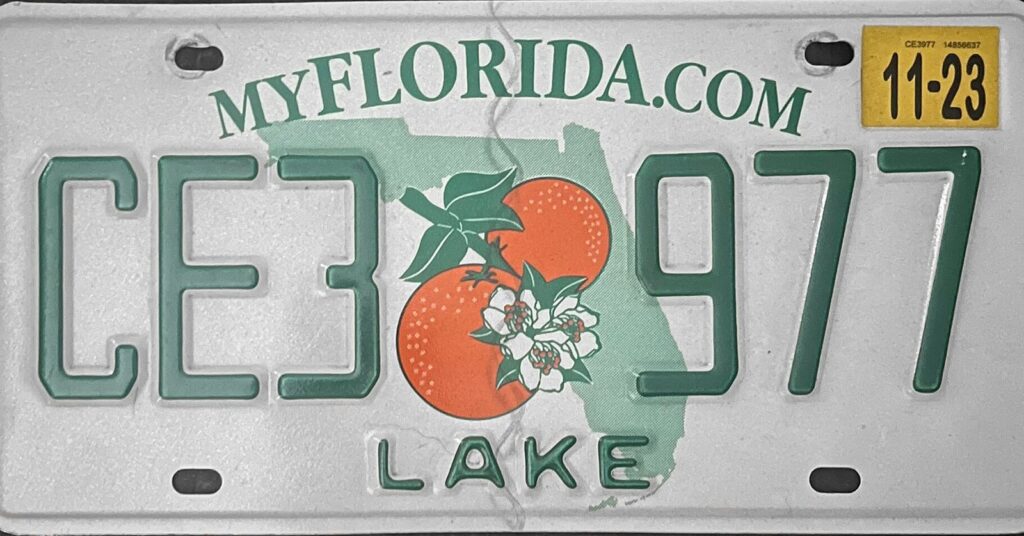
At least 50 officers nationwide — including two in Florida — have been accused of turning license-plate cameras into personal tracking tools. The logs that caught them are the same logs a defense lawyer can demand in your case.
A Washington Post investigation published August 2, 2026, found that at least 50 law enforcement officers across the country have been charged with or accused of misusing automated license-plate-reader systems — most of them Flock Safety’s network — to track people for personal reasons. In 26 of the cases, the targets were wives, girlfriends, ex-partners, an ex’s new partner, or women the officer wanted to meet. The investigation landed close to home: within days of publication, a Haines City officer was arrested after allegedly running 717 searches on his estranged wife’s vehicle, and the reporting itself appears to have prompted his admission to a supervisor.
The scale of the network explains the stakes. Flock operates more than 120,000 cameras across roughly 6,000 communities and records on the order of 20 billion plate scans every month. Each scan captures the plate, the vehicle’s make, model, and color, the time, and the camera location, and stores it in a searchable cloud database that participating agencies can share across jurisdictions. Roughly 140,000 law enforcement users have access.
Florida is already in the case file
Two of the documented cases come from Florida. In Orange City, Officer Jarmarus Brown ran his ex-girlfriend’s plate at least 69 times over about seven months — and searched her mother’s and father’s vehicles as well — before he was arrested. He pleaded no contest to unauthorized computer use and received five years of probation. In Niceville, Officer Coty Hall ran 192 improper searches tracking a former romantic partner. An internal audit caught it; he was fired and pleaded no contest to charges including computer misuse and stalking. Elsewhere, a Georgia police chief allegedly searched an ex-girlfriend’s plates roughly 600 times, many between midnight and 4 a.m., and a former California deputy who used the network against his former fiancée was sentenced to six years in prison.
The investigation also documented how thin the oversight can be. Officers often justify searches with a single word — one citizen analysis of a city’s audit logs found about 85 percent of queries carried one-word justifications like “investigation,” and fewer than 3 percent referenced a criminal case number. Flock has rolled out an optional audit-assistance feature that flags suspicious search patterns, but only about one in four agencies has turned it on. Thirteen states have adopted audit requirements and at least eight have made plate-reader misuse a specific crime. Florida has no ALPR-specific misuse statute; prosecutors here reach the conduct through the computer-crimes and official-misconduct laws, as the Haines City charges show.
What this means in an ordinary criminal case
It would be a mistake to read these stories as being only about rogue officers and their victims. They prove a structural point that matters to every defendant whose case touches a plate-reader database: the system logs everything, and the logs are evidence.
Florida law treats plate-reader data as regulated material. Under sections 316.0777 and 316.0778, Florida Statutes (2025), the images and resulting personal identifying information are confidential and exempt from public disclosure, retention is capped by a state schedule, and cameras placed in State Highway System rights-of-way must be tied to active criminal intelligence or investigative purposes. The statutes do not require a warrant and do not contain their own suppression remedy. But when a case is built on a database query, the defense can and should demand the complete audit record: the exact search terms, the date ranges, the stated purpose, the reason codes, every return the system produced, and the data-sharing settings that determined how far the search reached.
Those records feed two arguments. First, causation: if the query supplied the vehicle, the identification, or the warrant nexus, everything that followed depends on the legality of that access. Second, reasonableness: after Carpenter v. United States (2018) and the Supreme Court’s June 2026 decision in Chatrie v. United States — which held that obtaining even a limited period of a person’s location data from a technology company is a search — an officer’s compliance with agency policy, stated purpose requirements, and statutory limits bears directly on whether a warrantless query can be defended as objectively reasonable. A department that cannot produce a clean audit trail has a problem that the defense is entitled to explore.
If you have been charged in a case where the police found you, your car, or your route through a camera network, you do not have to accept the State’s version of how that happened. There is hope: Board Certified Criminal Trial Lawyer Tonmiel Rodriguez can demand the records behind the hit and put the State to its proof.
Statutes in this article
- Fla. Stat. § 316.0777 — automated license plate recognition systems — confidentiality and use
- Fla. Stat. § 316.0778 — staged automated license plate recognition systems — retention schedule
- Fla. Stat. § 815.06 — offenses against users of computers and electronic devices
- Fla. Stat. § 838.022 — official misconduct
Legally reviewed by Tonmiel Rodriguez · Last reviewed August 2026
Tonmiel Rodriguez is a criminal defense attorney in Bartow, Florida. If your case started with a plate-reader hit — a stop, an identification, or a warrant that traces back to a database query — in Polk, Highlands, or Hardee County, call The Rodriguez Law Office at (863) 774-4556.