

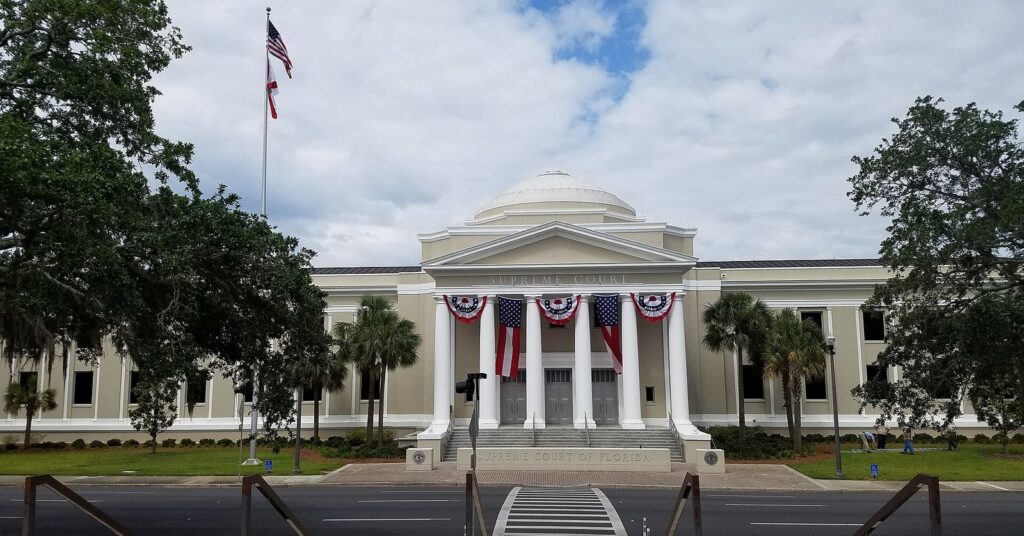
Welcome back to Florida Courts Watch, our recurring look at recent Florida appellate decisions that matter to people facing criminal charges. This edition takes up two rulings the Second District Court of Appeal handed down on the same day — July 10, 2026 — that circle the same question: when may police search without a warrant? Both cases were handled on appeal by the Public Defender’s office here in Bartow.
Second DCA — a “welfare check” is not a free pass into your home
The strongest Fourth Amendment protection anyone has is the protection of the home. A warrantless search of a residence is “per se unreasonable” under the Fourth Amendment and under article I, section 12, of the Florida Constitution, unless the State can fit the entry into a recognized exception. One of those exceptions is exigent circumstances — a true emergency, such as a person who needs immediate life-saving aid. But the officers must have an objectively reasonable basis for believing the emergency exists. A hunch is not enough.
In State v. Ford, No. 2D2025-0324, detectives investigating a woman’s disappearance went to the defendant’s house, knocked without an answer, called for a marked unit, and had an officer climb through a window to let everyone inside. They said they were performing a welfare check because of the man’s demeanor a day or two earlier. The trial court was not persuaded. It found that the detectives’ belief that life-saving care was needed rested on “a hunch or a guess or a speculation,” that no one had even looked through a window to confirm an emergency, that the officers had plenty of time to get a warrant, and that the manner of the entry “belie[d] the fact that there was any sort of exigency.” The court suppressed the evidence, and the State appealed.
On July 10, 2026, the Second District affirmed the suppression. Applying the standard from Seibert v. State, 923 So. 2d 460 (Fla. 2006), the panel deferred to the trial court’s findings, held that competent, substantial evidence supported them, and concluded that the detectives had no objectively reasonable belief in an exigency that would justify entering the home without a warrant. One judge dissented, reading the same record as supporting a reasonable welfare check. The takeaway for the rest of us: labeling an entry a “welfare check” does not make it lawful. When police have time to get a warrant and no concrete sign of an emergency, the warrant requirement still governs the front door.
Second DCA — “no objection” at trial can throw away a suppression fight you already had
The second case is a caution about how easily a good search-and-seizure argument can be lost — not on the merits, but on a single word at trial. In Lopez v. State, No. 2D2025-0319, the defendant was convicted of trafficking in fentanyl. Before trial he had moved to suppress the drugs, arguing that officers searched his pocket without a warrant while he was being treated for an overdose in a laundromat. The trial court denied the motion, finding that the search fell within the community-caretaking and emergency-medical exceptions. Then, at trial, when the State offered the fentanyl into evidence, defense counsel said “no objection.”
Those two words decided the appeal. Relying on Carr v. State, 156 So. 3d 1052 (Fla. 2015), the Second District held that affirmatively saying “no objection” at trial abandons the earlier motion to suppress and leaves nothing preserved for appeal — even though section 90.104(1), Florida Statutes, says a party “need not renew an objection” after a definitive pretrial ruling. A concurring judge wrote separately to flag the tension between that statute and Carr, noting that adding one word — “no further objection” — would likely have preserved the issue, and urging the Florida Supreme Court to revisit the question. That same judge added that, even if the issue had been preserved, the search of an actively overdosing man was a reasonable, minimally intrusive step to protect him and the paramedics treating him — so the outcome would have been the same either way.
For anyone with a pending case, the practical lesson is the one every good defense lawyer already lives by: winning or losing a motion to suppress is not the end of the fight. The objection has to be protected all the way through trial, and a reflexive “no objection” when the evidence is offered can quietly waive the very issue you built the defense around. If you want to understand how these search rules play out at the roadside and beyond, we have written about when police can pull you over in Florida and whether police can look through your phone.
Why these Second District cases matter in Polk County
Appeals from Polk County are heard by the Sixth District Court of Appeal, not the Second. But a decision from any district court of appeal binds every trial court in Florida when no other district has ruled the other way. Pardo v. State, 596 So. 2d 665 (Fla. 1992). Unless and until the Sixth District or the Florida Supreme Court says otherwise, both of these rulings guide the judges here in Bartow. That is why we watch every district, not just our own.
Cases & statutes in this edition
- State v. Ford, No. 2D2025-0324 (Fla. 2d DCA July 10, 2026) — opinion at CourtListener · opinion (PDF)
- Lopez v. State, No. 2D2025-0319 (Fla. 2d DCA July 10, 2026) — opinion at CourtListener · opinion (PDF)
- Seibert v. State, 923 So. 2d 460 (Fla. 2006) — exigent-circumstances standard · opinion at CourtListener
- Carr v. State, 156 So. 3d 1052 (Fla. 2015) — “no objection” abandons a pretrial suppression ruling · opinion at CourtListener
- § 90.104, Fla. Stat. (rulings on evidence; preservation)
- Pardo v. State, 596 So. 2d 665 (Fla. 1992) — opinion at Justia
Legally reviewed by Tonmiel Rodriguez · Last reviewed July 2026
Tonmiel Rodriguez is a criminal defense attorney in Bartow, Florida, and is Board Certified in Criminal Trial Law by The Florida Bar. If you have a pending case in Polk County and want to know whether one of these decisions affects it, call The Rodriguez Law Office at (863) 774-4556.