

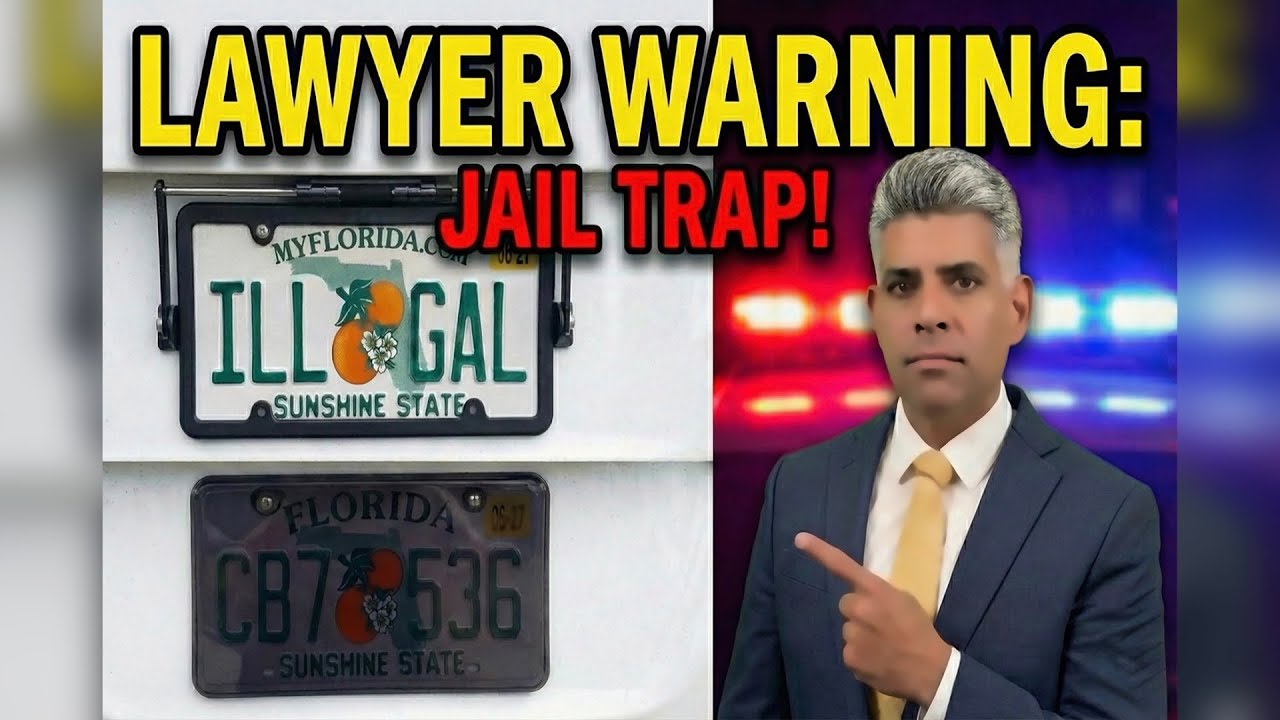
The license plate frame on your car right now — the one the dealership installed — could cost you a ticket, and in some cases 60 days in jail. A state memo told drivers the frames are fine. It only told them about one of the three laws. Here are all three, and who actually has something to worry about.
In the video above, I explain why the December 2025 state memo about license plate frames is dangerously incomplete. This article covers the same ground with the statutes in hand: the three laws that regulate what can touch your plate, which one is criminal, and what the memo’s own case law actually held.
What did the December 2025 memo actually say?
In December 2025, the Florida Department of Highway Safety and Motor Vehicles issued a memo to law enforcement about the state’s newest license plate law. The memo said that frames covering “MyFlorida.com” at the top of the plate and “Sunshine State” at the bottom do not violate that law, because those words are not “primary features” — only the plate number and the registration decal are. News outlets ran with it: tag frames are fine, don’t worry.
Here is the problem. The memo addressed one statute — the new one. It said nothing about the two older laws that have been on the books for years, and those two laws are much broader. One of them is criminal. Let me walk you through all three so you can see exactly where the memo’s reassurance runs out.
Statute one: the 100-foot rule (§ 316.605)
The first statute, section 316.605, Florida Statutes, has been around for decades. It requires that all letters, numerals, printing, writing, the registration decal, and the alphanumeric designation on the plate be “clear and distinct and free from defacement, mutilation, grease, and other obscuring matter, so that they will be plainly visible and legible at all times 100 feet from the rear or front.”
Note the word the memo skipped past: all. All letters, all writing — not just the plate number and the decal. That includes “MyFlorida.com” and “Sunshine State.” The good news is that violating this statute is only a noncriminal traffic infraction: a ticket and a fine, no arrest. But the ticket is not the real exposure. A frame that covers those words hands any officer a lawful reason to stop you — the pretextual stop I have written about before in the context of window tint. The plate is the stated reason; the look inside your car is the point. And once the stop is legal, whatever the officer sees, smells, or hears next — an open container, cannabis, a suspended license — can turn a tag ticket into a DUI arrest or worse.
Statute two: the one that can put you in jail (§ 320.061)
The second statute is the one that concerns me most, because it is criminal and the memo never mentioned it. Section 320.061 makes it a second-degree misdemeanor — up to 60 days in the county jail and up to a $500 fine — to apply or attach any substance, reflective matter, illuminated device, spray, coating, covering, or other material onto or around a license plate that interferes with the legibility, angular visibility, or detectability of any feature or detail on the plate.
Look at that language: any feature or detail. Not “primary features” — any feature. That reaches “MyFlorida.com,” “Sunshine State,” the orange graphic, everything. There is one real limit: the State has to prove you were the one who applied or attached the covering. If the dealership installed the frame and you just drove off the lot, this statute probably does not reach you. If you bought the frame online and installed it yourself, it can.
Statute three: the new anti-flipper law (§ 320.262)
The third statute is the one the memo actually addressed. Section 320.262 took effect on October 1, 2025. It targets license plate obscuring devices: plate flippers that switch or hide the plate, covers and sprays that block cameras, anything designed to defeat the plate’s primary features — which the statute describes as including the license plate number and validation sticker, a list the state memo reads as exclusive. The penalties escalate. Possessing one of these devices is a second-degree misdemeanor. Selling them is a first-degree misdemeanor, up to a year in jail. Using one to assist in a crime or to avoid detection is a third-degree felony, up to five years in prison.
This law was aimed at anti-enforcement devices — toll evaders and camera cheats — not at dealership frames, and that is why its focus is the plate number and the decal. The memo’s reading of this statute is defensible. The mistake was presenting it as if it were the only statute that matters.
What did State v. Morris actually hold?
The memo also leaned on a court case — a 2019 Fourth District decision it describes as “analyzing a similar statute (s. 320.061 F.S.).” That case is State v. Morris, 270 So. 3d 436 (Fla. 4th DCA 2019), and the memo’s description is wrong on the central point: Morris was decided under section 316.605 — the civil infraction — not the criminal statute. And its facts were narrow: a dealership frame partially covered a few letters of “Sunshine State” and “MyFlorida.com,” every word on the plate remained readable within 100 feet, and the officer admitted he had no trouble reading them. The court held that plate was lawful.
Note what the Morris court did not say. It did not say a frame may completely cover those words. It approved a partial overlap that left everything legible — nothing more. A conclusion that you may fully cover “MyFlorida.com” or “Sunshine State” is not in the opinion, and the memo never grappled with section 320.061 at all. A state memo is guidance for law enforcement; it is not binding law, and officers have charged drivers under these older statutes before.
So which frames are actually safe?
Make it simple. Always illegal: tinted or smoked plate covers, any spray or reflective coating, plate flippers and switching devices, and any frame that touches the plate number or registration decal. Risky gray zone: frames that completely cover “Sunshine State” or “MyFlorida.com” — the memo says the new law does not care, but section 316.605 supports a ticket and a stop, and section 320.061 can support a criminal charge if you installed the frame yourself. It is not worth it. Probably safe: thin frames that sit outside the printed area, or frames that at most partially overlap letters while every word stays readable from 100 feet — the Morris facts. And if you are buying a car, tell the dealership to skip the frame or use one that touches nothing printed.
If a license plate stop has already turned into a citation or an arrest, the stop itself is often the place a defense begins — the same way it is in tint cases. That is the full picture the memo left out.
Key moments
- 0:35 — What the DMV memo actually said
- 1:39 — Statute #1: the civil infraction and the pretextual-stop risk
- 3:10 — Statute #2: the criminal violation (§ 320.061)
- 4:34 — Statute #3: the new anti-flipper law (§ 320.262)
- 6:00 — Why State v. Morris is misunderstood
- 10:50 — Recap: what is safe vs. illegal
- Fla. Stat. § 316.605 — plate must be plainly visible and legible from 100 feet (noncriminal infraction)
- Fla. Stat. § 320.061 — attaching anything that interferes with any feature of the plate (second-degree misdemeanor)
- Fla. Stat. § 320.262 — license plate obscuring devices (effective Oct. 1, 2025; escalating penalties)
- State v. Morris, 270 So. 3d 436 (Fla. 4th DCA 2019) — opinion at CourtListener
- FLHSMV memo to law enforcement (Dec. 2025)
- Our guide to Florida window tint law and pretextual stops
- DUI defense at The Rodriguez Law Office — when a traffic stop turns into a DUI case
Full video transcript
That license plate frame on your car right now — the one the dealership installed — could land you in jail for 60 days and cost you $500 in fines. But you may be thinking: I thought the Florida DMV issued a memo saying those tag frames are legal. Here’s the problem. That memo is dangerously misleading. It only tells you about one law while ignoring two others that can actually send you to jail. I’m Tonmiel Rodriguez, a Florida board certified criminal trial lawyer, and today I’m cutting through that confusion to show you exactly which frames are legal, which ones can get you arrested, and why the DMV’s advice may cause trouble.
So, let’s start with what the DMV actually said. In December 2025, the Florida Department of Highway Safety and Motor Vehicles issued a memo to law enforcement. The memo said that frames covering “MyFlorida.com” at the top of the plate and “Sunshine State” at the bottom don’t violate Florida law, because those aren’t “primary features” — only the plate number and the decals are primary features. When this memo came out, news outlets started saying tag frames are fine, don’t worry about it. A lot of people breathed a sigh of relief. But here’s what nobody’s telling you. The memo only addressed one statute — Florida Statute 320.262, the brand new law that went into effect in October of last year. It said nothing about the other laws that have been on the books for years. And those two laws are much broader, and one of them can send you to jail for covering the very same things that the new law wouldn’t bother you for covering — that “MyFlorida.com” and “Sunshine State” on your tag. So, let me walk you through all three statutes and show you why that memo is so misleading.
The first statute is Florida Statute 316.605. This law has been around for decades. It requires that all letters, numerals, printing, writing, the registration decal, and the alphanumeric designation must be clear and distinct and free from defacement, mutilation, grease, and other obscuring matter, so that they will be plainly visible and legible at all times 100 feet from the rear. Notice that it says all letters and all writing — not just the plate number and the decal. Everything on the plate, including “MyFlorida.com” and “Sunshine State.” The DMV memo completely ignored this statute. Now, the good news is that violating the statute is only a civil traffic infraction. You get a ticket, you pay a fine — no arrest, no jail time. But here’s the thing. If your frame completely covers “MyFlorida.com” or “Sunshine State,” you’re violating this law regardless of what the DMV memo says, and you’re exposing yourself to, at the very least, what is known in the law as a pretextual traffic stop — where the officer uses the technical violation as a pretext for a fishing expedition into an offense that he doesn’t have a basis to stop you for.
The second statute is Florida Statute 320.061, and this is the one that is most concerning, because it is criminal. It makes it a second-degree misdemeanor — punishable by up to 60 days in the county jail and up to a $500 fine — to apply or attach any substance, reflective matter, illuminated device, spray, coating, covering, or other material onto or around any license plate which interferes with the legibility, angular visibility, or detectability of any feature or detail on the license plate. Look at that language: any feature or detail — not just “primary features” like the new law specifies. Any feature. That means “MyFlorida.com,” “Sunshine State,” the little orange graphic — everything on the plate. The DMV memo also completely ignored this statute. Now, there is one catch with this law: they have to prove that you were the one who actually attached or applied it. So, if the dealership installed the frame and you just drove off the lot, this probably doesn’t apply to you. But if you bought it online and installed it yourself, you could face criminal charges.
The third statute is the one the DMV memo actually addressed: Florida Statute 320.262. This law went into effect on October 1st, 2025, and it prohibits license plate obscuring devices designed to switch between multiple license plates, flip the plate to hide the number, cover or interfere with the “primary features” — which the law defines as the plate number and registration decal only — or block cameras from recording those primary features. This law has escalating penalties. Possession of one of those devices is a second-degree misdemeanor — that’s 60 days in jail. Selling those devices is a first-degree misdemeanor, punishable by up to one year in jail. And using them to commit a crime is a third-degree felony, punishable by up to 5 years in prison. Here’s the thing about this law: it was designed to target anti-enforcement devices — license plate flippers, camera-blocking sprays, devices specifically made to avoid traffic cameras and toll readers. That’s what the legislature was going after. And yes, it only prohibits covering primary features, which is why the DMV memo focused on this statute and that specific language. But the DMV memo made it sound like this is the only law that matters, and that’s dangerously misleading, because the other two laws — especially 320.061 — are much broader in scope.
Now, the DMV memo also cited a court case to support its position. It cited State v. Morris, a 2019 case, and said the case analyzed section 320.061, the criminal statute. But that’s not accurate. The Morris case actually analyzed section 316.605 — the civil traffic infraction, not the criminal one. And what did Morris actually say? The court ruled that a frame that partially covered some letters was okay, as long as all the words could still be clearly read from 100 feet away, as is required by that specific statute. The key word there is partially. The court never said it’s okay to completely cover words like “MyFlorida.com” or “Sunshine State.” So the DMV memo’s conclusion — that you can completely cover these words — is based on a misreading of the case law. And more importantly, the memo never addressed whether completely covering those words would violate section 320.061, the criminal statute that can send you to jail. This is a problem because the memo, even if it had been a correct legal analysis, isn’t really binding on law enforcement agencies. And there are police who have charged people under 320.061 and 316.605 for partially obscuring “MyFlorida” and “Sunshine State.”
Let me show you how this plays out with five common situations. First, let’s say John bought a car and the dealership installed a frame with their logo. It completely covers “Sunshine State” at the bottom, but it doesn’t touch the plate number or the decal. According to the DMV memo, John should be fine, because “Sunshine State” isn’t a primary feature under section 320.262. But under section 316.605, John is violating the law, because “Sunshine State” must be visible from 100 feet. That’s a traffic ticket. And under section 320.061, it’s potentially criminal — if they can prove John installed it himself. Now, if the dealership installed it and John just drove away, he probably can’t be charged criminally, but he could still get a traffic ticket under 316.605.
Here’s the second scenario. Tim bought a frame on Amazon and installed it. It covers the words at the top and the bottom, but not the plate number or the decal. According to the DMV memo, Tim should be fine. But under section 316.605, that’s a traffic ticket. And under section 320.061, that’s a criminal violation, because Tim installed it himself — up to 60 days in jail, $500 fine.
The third scenario: Francis bought a tinted plastic cover from Walmart. It goes over her entire license plate. Francis is violating all three laws. Under 316.605, the tint prevents everything from being clear and distinct. Under 320.061, it’s a criminal violation if she installed it. And under 320.262, it interferes with the primary features and prevents cameras from recording them clearly. These tinted covers are clearly illegal across the board.
The fourth scenario: Sam really doesn’t like red light cameras, so he installed a device that can flip his license plate to hide it. Plus, he sprayed it with reflective coating so cameras can’t read it if he happens to forget to flip the license plate. Sam is violating all three laws. Under 316.605, there’s a violation. Under 320.061, a criminal violation, because the spray is explicitly prohibited as a coating or spray. Under 320.262, a serious violation, because the flipper device is explicitly prohibited — and if he uses it while committing a traffic crime or other crime, it could become a third-degree felony, up to 5 years in prison. Sam is in the most trouble of anyone here. These devices are specifically what section 320.262 was designed to target.
Here’s the last scenario. Joe runs an online shop selling camera-blocking sprays, license plate flippers, and similar devices. Joe isn’t driving with these devices, so sections 316.605 and 320.061 don’t apply to him directly. But under section 320.262, selling these devices is a first-degree misdemeanor, punishable by up to one year in jail and a $1,000 fine.
All right, let me make this simple for you. Always illegal — stay away from these: tinted or smoked license plate covers, any spray or coating or reflective materials, license plate flippers or switching devices, and frames that cover your plate number or registration decal. Legal gray area — risky territory: frames that completely cover “Sunshine State.” The DMV says these don’t violate the new law, section 320.262, and that’s technically true. But they likely violate section 316.605, which means you can get a traffic ticket, and they may violate section 320.061, which means you could face jail time if you install them yourself. A suggestion: it’s not worth the risk. What’s probably safe? Thin frames that don’t touch any letters, numbers, or words — or frames that only partially obscure letters but keep all words clearly readable from 100 feet. If you want zero legal risk, use a frame that sits completely outside the printed area of your license plate, or don’t use a frame at all. And if you’re buying a car, tell the dealership you don’t want that license plate frame, or ask for one that doesn’t touch any printed area.
Look, Florida license plate laws are confusing. The new law, section 320.262, was meant to target people evading traffic cameras, not everyday drivers with dealership frames. But the two older laws are still on the books and enforceable, and they’re much broader than most people realize. The DMV memo tried to clarify things, but only made it worse by giving people a false sense of security about one law while ignoring the other two. If you have been cited or arrested for a license plate violation, call a criminal defense attorney immediately. These laws are complex, and there are defenses available depending on your situation. I’m Tonmiel Rodriguez, a Florida board certified criminal trial lawyer. If you found this video helpful, please like and subscribe. I break down Florida criminal laws so that you can stay informed and protect your rights. Thanks for watching, and I’ll see you in the next one.
Legally reviewed by Tonmiel Rodriguez · Last reviewed July 2026
Tonmiel Rodriguez is a criminal defense attorney in Bartow, Florida, and is Board Certified in Criminal Trial Law by The Florida Bar. He defends people facing DUI, drug, weapons, and other criminal charges in Polk County and throughout Central Florida. If a traffic stop turned into an arrest or a criminal charge, call The Rodriguez Law Office at (863) 774-4556 to discuss your case.