

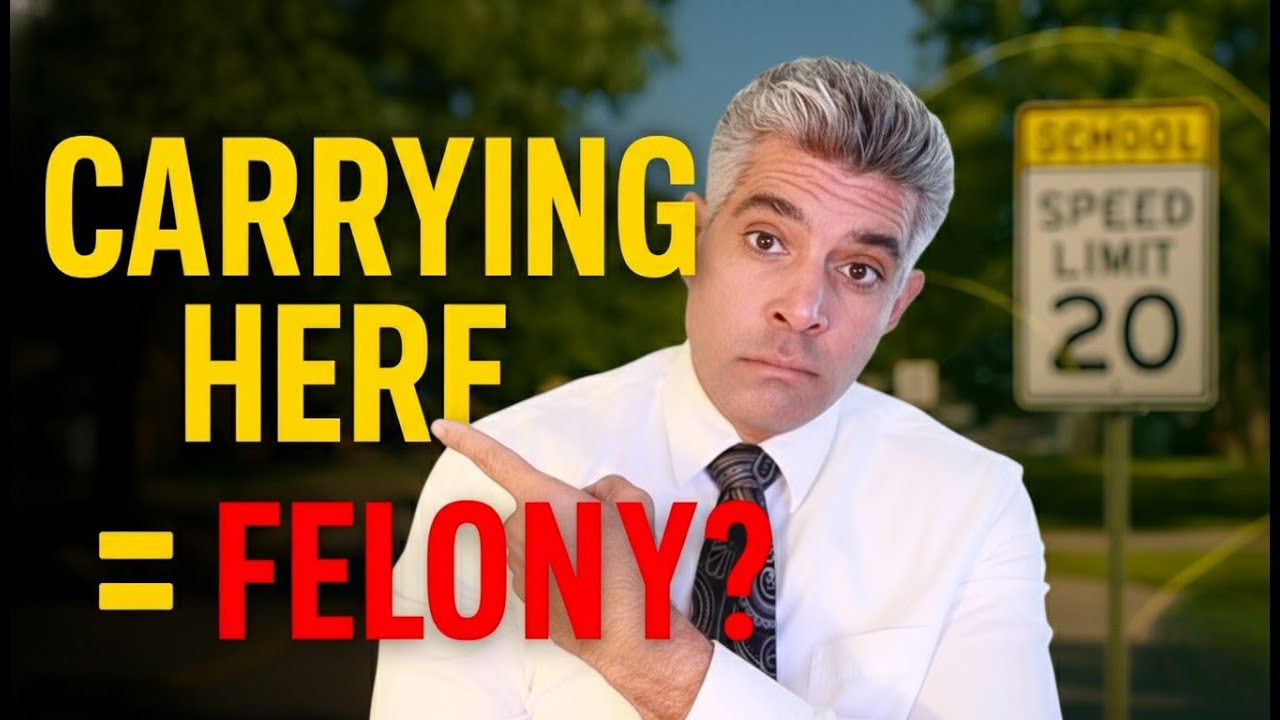
You can follow every gun law in your state, do everything right, and still commit a federal felony — not because of what you do, but because of where you are. This guide explains the Gun-Free School Zones Act: the 1,000-foot rule, the exceptions that keep lawful carriers out of federal court, and the real case of a homeowner prosecuted for standing in front of his own house.
In the video above, I answer the questions viewers asked after my video on open carry in vehicles: What if my house sits in a school zone? What if I only walk or drive through one? Can I really be prosecuted for that? This article covers the same ground with the statutes and cases in hand — including where the strict letter of the law and common sense part ways.
What does the Gun-Free School Zones Act actually prohibit?
The Gun-Free School Zones Act, 18 U.S.C. § 922(q), is a federal law, which means it applies on top of anything Florida says about firearms. It makes it a crime — punishable by up to five years in federal prison — for any individual knowingly to possess a firearm (one that has moved in or affects interstate commerce — which describes virtually every firearm) at a place the individual knows, or has reasonable cause to believe, is a school zone. Federal law defines a school zone as in or on the grounds of a public, parochial, or private school, and within 1,000 feet of those grounds.
Read that definition again, because it is doing a lot of work. One thousand feet, measured as the crow flies in every direction, reaches past the school building and its property to the sidewalks, streets, and neighborhoods around it. Note what the statute does not require. It does not require bad intent. It does not require threatening conduct. It does not require that you ever set foot on school property. “Knowingly” refers to knowing you have the firearm — and mere possession inside the zone, without an exception, is the crime.
Does the government have to prove you knew you were near a school?
Yes — and that element has teeth. The statute requires proof that you knew, or had reasonable cause to believe, you were in a school zone. In United States v. Guzmán-Montañez, 756 F.3d 1 (1st Cir. 2014), a man was convicted of possessing a firearm in a school zone at a fast-food restaurant that sat less than 1,000 feet from a school. The First Circuit reversed that count. The parties had stipulated the distance, but the only evidence that the defendant knew a school was nearby was one officer’s statement that the school was visible from the restaurant — and the court held that was not enough. Proximity alone does not prove knowledge.
Do not build a defense strategy on that case, though. Reversals like Guzmán-Montañez are rare. There is usually a school sign, a crossing zone, a playground — and prosecutors know to put on testimony showing you should have known. “If I didn’t know, I can’t be guilty” is common sense. “If you should have known, that’s enough” is the law.
Which exceptions actually protect you?
Congress built safe harbors into the statute, and they are the difference between lawful possession and a felony. Three matter for ordinary gun owners. First, the private property exception: possession on private property that is not part of school grounds — your home, your yard, your driveway — is not covered by the ban, even inside the 1,000-foot radius. Second, the license exception: the ban does not apply if you are licensed to carry by the state in which the school zone sits. For us, that means an actual Florida concealed-carry license. This is so because Florida’s permitless-carry framework does not put a license in your hand — and the federal exception turns on the license itself. This is one of the best reasons to still get the license even though Florida no longer requires it. Third, the unloaded-and-locked exception: a firearm that is unloaded and locked in a container, or locked in a firearms rack on a motor vehicle, is covered even without any license. That is the safest way to travel through a school zone, period.
There are a few other exceptions — law enforcement, approved school programs — but here is the catch that runs through all of them: they protect you only while you are inside them. Step outside one, even briefly, and you are rolling the dice.
How does this play out in everyday situations?
Take the five scenarios from the video. A woman who lives across the street from an elementary school takes her evening walk with a holstered firearm: the moment she steps off her driveway onto the sidewalk, she needs a license or she is technically in violation. A man whose backyard fence borders the high-school ball field is fine walking his own fence line — and exposed one step past it. A commuter whose only route to work passes a middle school with a loaded handgun in the console commits a technical violation every morning; there is no “only route available” exception. A driver who passes a school without stopping is in the same position — intent does not matter; location, presence, and possession do. And a rideshare driver who keeps a firearm in the car repeats that violation at every school drop-off.
Will any of them be prosecuted? Usually not. Enforcement runs on two things: discovery and discretion. In practice, this charge gets tacked on by federal prosecutors when something else draws attention — a traffic stop, a complaint, a visible firearm making people nervous. But discretion is not a defense, and it is not predictable. You cannot control whether a prosecutor picks up the file. You can only control whether you are standing inside an exception when it happens.
What happened in United States v. Metcalf?
For anyone who doubts this law gets enforced against ordinary people, consider United States v. Metcalf, No. 24-4818 (9th Cir. Sept. 23, 2025). Gabriel Metcalf lived directly across the street from an elementary school in Billings, Montana. After a neighbor threatened his mother, he carried a firearm outside his home — he never entered school property, never threatened anyone with the gun. Montana is a permitless-carry state whose legislature declared that eligible residents are considered licensed for exactly this purpose. Federal prosecutors charged him anyway, arguing Montana’s scheme did not satisfy the federal license exception’s requirements, and the trial court refused to dismiss the charge. Metcalf entered a conditional guilty plea — a felony conviction — preserving his right to appeal. It took the Ninth Circuit to undo it: the court held that Metcalf’s reading of the license exception was at least plausible, and that fair-notice principles and the rule of lenity barred punishing him for trusting his state’s law.
Metcalf won — after being federally prosecuted, convicted, and forced to fight through an appeal. The exception saved him from a record, not from the ordeal. Also, note what Metcalf does not do for Floridians: Florida’s permitless-carry law, unlike Montana’s, does not even purport to deem you “licensed.” If you carry near schools in Florida without an actual license, you do not have Metcalf’s argument. You have his ordeal without his lifeline.
The bottom line: if you live near a school, know where the 1,000-foot line runs. If you drive through one, either hold a qualifying license or keep the firearm unloaded and locked. You can live inside the exceptions, or you can live on luck — but you cannot live on both.
Key moments
- 1:10 — What the Gun-Free School Zones Act actually says
- 2:17 — The knowledge requirement
- 2:50 — The exceptions: private property, license, unloaded-and-locked
- 4:31 — Five real scenarios from viewer questions
- 7:20 — United States v. Metcalf: a homeowner prosecuted
- 8:57 — When this law actually gets enforced
- 18 U.S.C. § 922(q) — the Gun-Free School Zones Act (penalty: up to five years, 18 U.S.C. § 924(a)(4))
- United States v. Metcalf, No. 24-4818 (9th Cir. Sept. 23, 2025) — opinion (PDF)
- United States v. Guzmán-Montañez, 756 F.3d 1 (1st Cir. 2014) — opinion at CourtListener
- Fla. Stat. § 790.115 — Florida’s separate ban on firearms on school property
- Fla. Stat. § 790.06 — Florida’s concealed-carry license
- Open Carry in Your Car in Florida: 3 Legal Traps — the companion guide
- Weapons & firearm charge defense — The Rodriguez Law Office
Full video transcript
You can follow every gun law in your state, do everything right, and you still commit a federal felony. Not because of what you do, but because of where you are. Walk past a school, drive down a street, stand in front of your house that happens to sit within 1,000 feet of a school, and suddenly you’ve crossed a federal line most people don’t even know exists. Your common sense would tell you you’re safe. The letter of the law says you’re not. And the space between those two is where good people get into trouble. I’m Tonmiel Rodriguez, a Florida board certified criminal trial lawyer. In my last video about open carry and cars, we discussed the Gun-Free School Zones Act and how it applies to open carry in cars. A lot of you asked great follow-up questions like: What if my house is in a school zone? What if I walk or drive through one with no intention of stopping? What if I just drop somebody off? Can I really be prosecuted for this? This video is my response to those questions — and where some of you may find that the strict letter of the law and common sense part ways. We’ll look at five scenarios based on your questions and how the law applies to them. And we’ll discuss a real case, United States v. Metcalf, where a homeowner was charged and convicted for doing something most people would call reasonable. So, let’s dive in.
The Gun-Free School Zones Act is found at 18 U.S.C. section 922(q). It’s a federal law, meaning it applies above and beyond any state law regulating firearms. It makes it a felony for any individual knowingly to possess a firearm at a place the individual knows or has reasonable cause to believe is a school zone. A school zone is defined as in or on the grounds of a public, parochial, or private school, and within 1,000 feet of that school’s property line. That’s 1,000 feet as the crow flies, in every direction. Not just the school building and its property, but sidewalks, streets, and neighborhoods around it.
“Knowingly” means you’re aware you have a firearm on you. So no bad intent or evil purpose behind that possession is required. No threatening conduct is required. Just possession. You must also know or have reasonable cause to believe you’re in a school zone. That offers some protection. In United States v. Guzmán-Montañez, a conviction was overturned on appeal because although the school was within a thousand feet, prosecutors failed to prove that the defendant knew or should have known that fact. Evidence of proximity — meaning him being close by — is not enough. But this is rare. There’s usually a school sign, there’s a playground or other indicator, and the prosecution is usually smart enough to present testimony to demonstrate how the defendant knew or should have known it was a school zone. And that’s all it takes to show knowledge. Common sense may say, “If I didn’t know, I can’t be guilty.” Federal law says, “If you should have known, that’s enough.”
Now, here’s where you get some relief. Congress built in a few exceptions. An exception means that the law doesn’t apply to you if you fulfill certain conditions. These are your legal safe harbors. In other words, if you meet one of these conditions, you’re not violating the law, even if you’re inside that 1,000-foot radius. So, let’s start with the private property exception. If you’re on private property that’s not part of school grounds — your home, your yard, your driveway — you’re covered. Once you step off your property onto a public sidewalk or street, you are exposed unless you’re licensed to carry in Florida. Why? Because there’s a license-to-carry exception. If you have a valid State of Florida issued concealed carry permit, you’re covered. This is one of the reasons to still get your permit. Then there’s the unloaded-and-locked exception. If your firearm is unloaded — no bullets in it — and locked in a container or a gun rack on a motor vehicle, you’re covered even without a concealed carry permit. This is the safest way to travel through a school zone. So, these are your lifelines — the difference between lawful possession and a felony. There are a few other exceptions, like exceptions for law enforcement and certain school programs, that are beyond the scope of our discussion. But here’s the catch: these exceptions only protect you if you’re inside of them. You step outside, even briefly, and you’re rolling the dice.
To illustrate this, let’s go over the five scenarios I came up with based on your comments and questions. Take Sally. She lives across the street from an elementary school. She takes evening walks with her firearm holstered on her hip. Once she steps off her driveway and onto the sidewalk, she’s within the thousand-foot school zone. So unless she has a valid license to carry or her firearm is unloaded and locked, she’s technically violating federal law. Would she be prosecuted? This would depend on many factors, including being discovered — so perhaps not. But nothing in the law prevents it. All it takes is one call about a woman with a gun near a school for things to escalate.
Now, take John. John’s backyard fence borders the high school baseball field. He walks the fence line with his firearm. As long as he stays on his property, he’s fine. One step beyond that fence and he’s not. Would a prosecutor pursue it? Again, that depends on the circumstances, including how and why police got involved in the first place. So, probably not. But the law wouldn’t prevent his prosecution if he stepped over the line armed. If John takes that risk, he’s leaving his freedom up to chance.
Here’s Mike. Mike’s only route to work passes a middle school. His loaded handgun is in the center console. But here’s the catch: there is no “this is the only route available” exception. He either needs a qualifying license or he must keep the gun unloaded and locked. Without that, he’s committing a technical violation every morning. And if he’s stopped for speeding, that small discovery could become a federal case. It may never happen. But does he want to roll the dice?
Now take Maria. She’s driving home with a loaded handgun in her glove box. She passes a school — doesn’t stop, just drives through. She has no intention to stop. But intent doesn’t matter. Location, presence, and possession matter. If she doesn’t meet an exception, she’s technically in violation, even if she never set foot on the school property. She may never face prosecution, for any number of reasons — for example, she may never be caught in the act. Prosecutorial discretion may save her even if she were caught. But the letter of the law is clear, and prosecutorial discretion is not always predictable, and certainly is always circumstantial.
And here we have Daniel, a rideshare driver. Daniel drives for a rideshare app. He keeps a firearm in his car for protection. Every time he drops off a passenger at a school, he’s within the 1,000-foot zone. If he doesn’t have a qualifying license or keep his firearm unloaded and locked, he’s committing a technical violation over and over again. And again, whether he’s ever charged depends on two things: discovery and discretion.
For those of you who doubt that prosecution under the Gun-Free School Zones Act actually happens, take the case of United States v. Metcalf. Metcalf lived across the street from a public school in Montana. He had a valid license to carry recognized by the State of Montana. One day, he carried his firearm while standing outside his home, in case he needed to protect his mom from a neighbor that had threatened her. He didn’t use the firearm. He didn’t threaten or harass anyone with it. He just carried it. He never entered school property. But some neighbors were concerned and called police. He was ultimately charged under the Gun-Free School Zones Act, even though Montana law treated him as licensed and he arguably fell under that exception. Why? Because the federal prosecutor believed Montana’s licensing scheme did not meet the federal requirements. He was convicted, and then he appealed. The Ninth Circuit Court of Appeals reversed his conviction, finding that he was covered by the license-to-carry exception’s protection because he had no reason to know that Montana’s unique licensing process might not meet federal requirements. So Metcalf ultimately won — but only after being convicted and fighting through appeals. The exception saved him from a permanent record, but not from the ordeal.
So when does this law actually get enforced? The short answer: whenever they choose to. If possession, proximity, and lack of an exception are proven, the case is chargeable. Whether it’s actually charged depends on discretion. What you do see is that this crime is often accompanied by other offenses — so it’s tacked on by federal prosecutors, perhaps as a negotiating tactic for leverage. Or you may see it charged in situations where no state law clearly criminalizes the person’s behavior — like someone camping out near a school with a firearm in his vehicle, causing concern to citizens — and so authorities can act on that basis where they would not have been able to otherwise. So context matters: visible firearm, complaint, public safety concern. But the reality is that you can’t control prosecutorial discretion. You can only control your behavior and whether you stay under an exception.
So, bottom line: if you live near a school, know where that 1,000-foot line is. If you drive through one, either have a qualifying license or make sure your firearm is unloaded and locked. You can live inside the exceptions, or you can live on luck — but you can’t live on both. Metcalf proves that even a responsible gun owner can become a test case. He was lucky. Others may not be. Where the letter of the law is clear, the real-world application is often unpredictable. And when those two collide, law enforcement usually wins — even if you win later on appeal. If you want to take the uncertainty out of it, follow an exception every single time. I’m Tonmiel Rodriguez, a Florida board certified criminal trial lawyer. If you found this video helpful, please like, please subscribe, and share with somebody who needs to know. Thanks for watching, and I’ll see you in the next one.
Legally reviewed by Tonmiel Rodriguez · Last reviewed July 2026
Tonmiel Rodriguez is a criminal defense attorney in Bartow, Florida, and is Board Certified in Criminal Trial Law by The Florida Bar. He defends people facing weapons, DUI, drug, and other criminal charges in Polk County and throughout Central Florida. If a firearm charge — state or federal — has entered your life, call The Rodriguez Law Office at (863) 774-4556 to discuss your case.